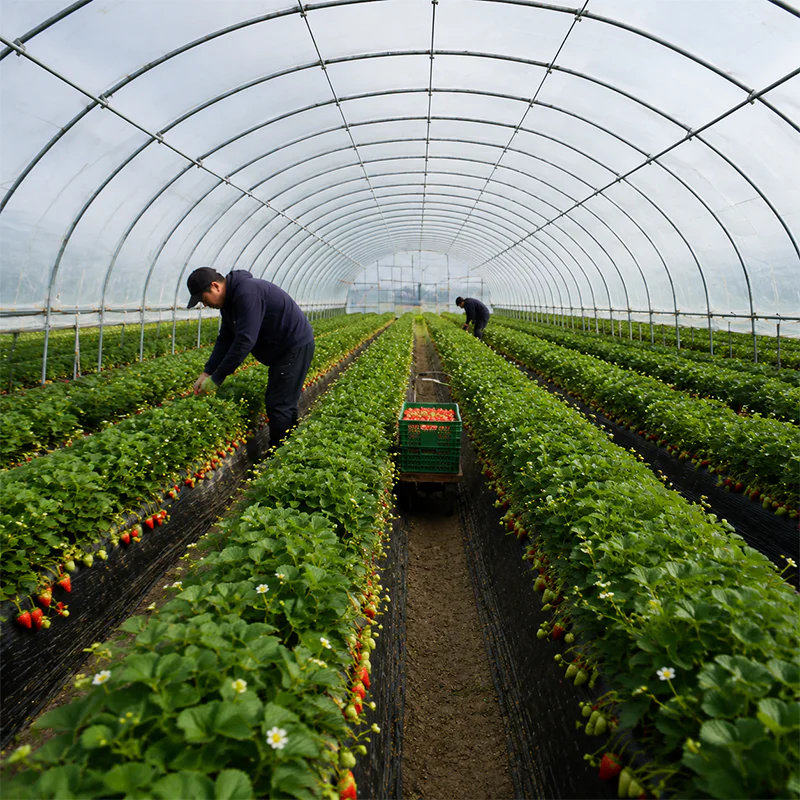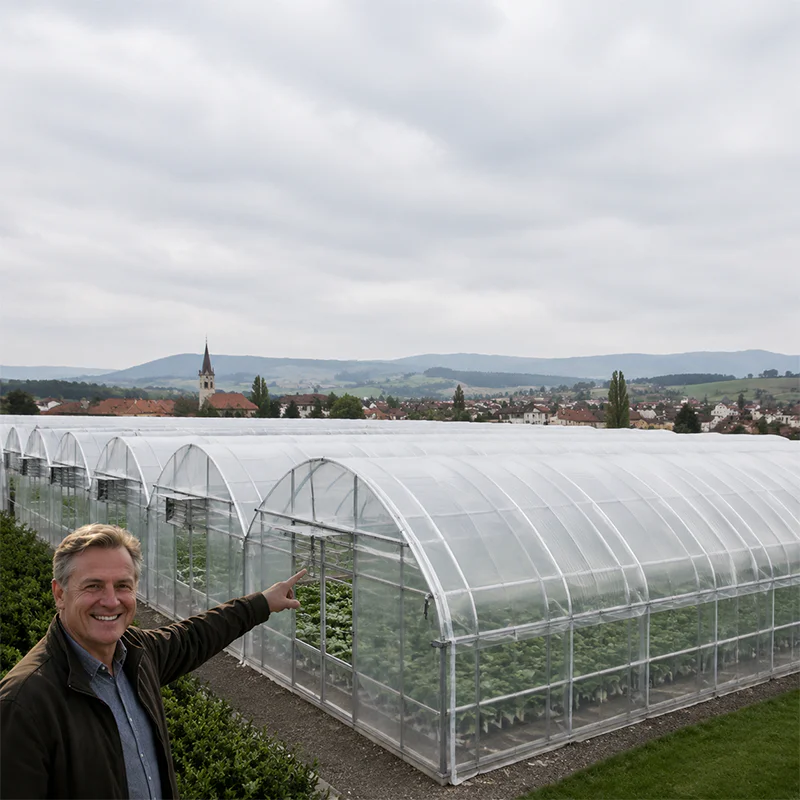






For commercial growers in hot and humid regions, greenhouse ventilation is not a small detail. Poor airflow can lead to heat stress, high humidity, plant disease, uneven growth, and unstable crop quality.
This is why many growers compare a sawtooth greenhouse with a traditional greenhouse before starting a project. A sawtooth greenhouse is usually more suitable for farms that need stronger natural ventilation and faster heat release. A traditional greenhouse may be enough for mild climates, simple seasonal growing, lower budget projects, or small scale farms.
The main difference is the roof design. A sawtooth greenhouse uses a stepped roof with raised ventilation openings, helping hot air escape from the upper part of the greenhouse. A traditional greenhouse usually uses an arch, tunnel, or gable roof and may rely more on side vents, roof vents, exhaust fans, cooling pads, or shading systems.
This guide compares both greenhouse designs from a practical commercial farming perspective, including roof design, natural ventilation, heat release, humidity control, cooling system requirements, cost, crops, climate suitability, and project selection.
What Is a Sawtooth Greenhouse
A sawtooth greenhouse is a greenhouse structure with a stepped roof shape. The roof looks similar to the teeth of a saw, with raised openings designed for ventilation.
The basic working principle is simple: hot air rises. When the upper roof vents are properly positioned, hot and humid air can escape more easily, while fresh air enters from the side openings. This helps create better air exchange inside the greenhouse.
A Single Span Sawtooth Greenhouse is often used for smaller farms, trial projects, independent growing areas, or lower investment projects. A Multi Span Sawtooth Greenhouse is more suitable for larger commercial farms that need more planting space, better layout efficiency, and more stable environmental management.
In real projects, the performance of a sawtooth greenhouse depends on several design details, including roof vent direction, greenhouse height, span width, side ventilation, covering material, local wind direction, rainfall, and crop layout. A good design should consider all these factors before construction.
What Is a Traditional Greenhouse
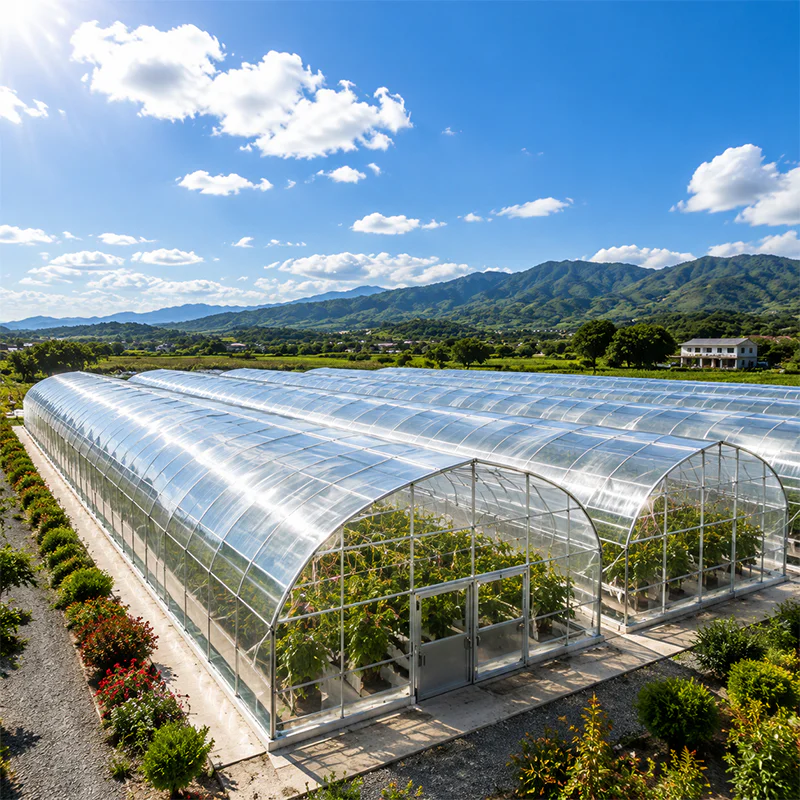
A traditional greenhouse usually refers to a standard greenhouse structure, such as an arch greenhouse, tunnel greenhouse, gable greenhouse, or conventional multi-span greenhouse. These structures are widely used because they are simple, flexible, and suitable for many types of farming projects.
Traditional greenhouses can be covered with PE film, PO film, polycarbonate sheets, or glass. Ventilation is usually provided through side vents, roof vents, doors, exhaust fans, cooling pads, or natural airflow, depending on the design.
In mild climates, a traditional greenhouse can work very well. It can protect crops from rain, wind, insects, and temperature changes while keeping the structure relatively simple.
However, in hot or humid regions, a traditional greenhouse may face more pressure in temperature and humidity control. If the roof ventilation is limited, hot air can stay near the top of the structure. Growers may then need stronger mechanical cooling or more careful ventilation management.

Sawtooth Greenhouse vs Traditional Greenhouse Key Differences
Roof Design
The roof design is the most obvious difference between these two greenhouse types.
A sawtooth greenhouse has a stepped roof with raised ventilation openings. This structure creates a clear outlet for hot air. In warm climates, this roof form helps the greenhouse release heat more naturally during the day.
A traditional greenhouse usually has an arch, tunnel, or gable roof. These structures are simple and widely used, but they do not always release hot air as efficiently unless roof vents, fans, or other ventilation systems are added.
For commercial growers, roof design is not only about appearance. It directly affects temperature, humidity, airflow, cooling cost, and daily crop management.
Natural Ventilation
Natural ventilation is one of the strongest advantages of a sawtooth greenhouse. As hot air rises, it can escape through the upper roof vents. At the same time, cooler outside air can enter through the side openings.
This design is useful for farms that want to reduce dependence on exhaust fans or lower energy use during warm seasons. It does not mean mechanical cooling is never needed, but it gives the greenhouse a better natural airflow foundation.
Traditional greenhouses can also use natural ventilation. However, the effect depends on vent size, greenhouse height, wind direction, internal layout, and roof design. In some hot and humid areas, side vents alone may not be enough for stable commercial production.
Heat Release
Heat buildup is one of the most common problems in greenhouse farming. When the internal temperature becomes too high, crops may grow slowly, flowers may drop, fruit quality may decline, and irrigation demand may increase.
A sawtooth greenhouse helps solve this problem by giving hot air a higher escape point. This is especially helpful during sunny afternoons or in regions with long hot seasons.
A traditional greenhouse may trap more hot air near the roof if the structure has limited upper ventilation. In that case, growers often need additional cooling systems, such as exhaust fans, cooling pads, misting systems, or shading nets.
Humidity Control
Good humidity control is important for crop health. High humidity can increase disease pressure and weaken plant growth, especially in dense vegetable or flower production.
A sawtooth greenhouse supports stronger air movement, which helps reduce stagnant humid air inside the growing area. This is useful for crops with dense canopies, such as tomatoes, cucumbers, flowers, and leafy vegetables.
A traditional greenhouse can also manage humidity, but it often needs a carefully designed ventilation system. If humidity stays high for too long, growers may need to adjust irrigation timing, increase airflow, add fans, or improve roof ventilation.
Cooling System Requirements
A well designed sawtooth greenhouse can reduce the workload of cooling systems. The roof vents help remove heat naturally, so fans and cooling pads may not need to work as heavily in suitable climates.
This does not mean a sawtooth structure never needs cooling equipment. In very hot regions or high density production, cooling pads, exhaust fans, shading systems, and automation may still be needed. The benefit is that natural ventilation helps reduce cooling pressure.
Traditional greenhouses may require more active cooling in hot regions. If the roof cannot release heat efficiently, growers may need stronger fans, larger cooling pads, or more shading to maintain crop comfort.
Structure Cost and Maintenance
A traditional greenhouse is usually simpler in structure and may have a lower initial cost, especially for small scale or seasonal projects.
A sawtooth greenhouse can require more careful engineering because of the roof vent design, frame layout, wind resistance, rain protection, and covering installation. The initial cost may be higher than a very simple traditional structure.
However, for commercial farms in warm regions, the improved ventilation can be valuable. Growers should compare not only construction price, but also long term cooling demand, crop stability, maintenance, and production efficiency.
An economical sawtooth greenhouse can also be designed by choosing a suitable span, practical ventilation configuration, and cost effective covering material. The goal is not always to build the most expensive structure, but to build the most suitable one.
Suitable Climate Conditions
A sawtooth greenhouse is generally more suitable for hot, humid, tropical, and subtropical regions. It is also a strong option for farms that need natural ventilation and lower heat accumulation.
A traditional greenhouse is often suitable for mild climates, cooler areas, seasonal growing, and projects where ventilation demand is not extremely high.
In areas with strong wind, heavy rain, or snow, both greenhouse types need proper structural design. The final choice should be based on local climate data, crop requirements, and project budget, not only the greenhouse shape.

Sawtooth Greenhouse vs Traditional Greenhouse Comparison Table
| Comparison Item | Sawtooth Greenhouse | Traditional Greenhouse |
|---|---|---|
| Roof Design | Stepped roof with raised vents | Arch, tunnel, gable, or standard roof |
| Natural Ventilation | Stronger roof ventilation | Depends on side vents, roof vents, or fans |
| Heat Release | Better hot air discharge | May trap heat if roof ventilation is limited |
| Humidity Control | Better air exchange helps reduce humidity buildup | Requires careful ventilation design |
| Cooling System Pressure | Lower in suitable climates | Usually higher in hot areas |
| Initial Cost | Usually higher than very simple structures | Often lower for basic designs |
| Maintenance | Needs attention to roof vents and covering details | Usually simpler for small projects |
| Suitable Climate | Hot, humid, tropical, subtropical | Mild, seasonal, or simple growing areas |
| Suitable Crops | Vegetables, flowers, seedlings, hydroponic crops | Vegetables, seedlings, seasonal crops |
| Commercial Use | Strong for farms needing natural airflow | Good for standard crop protection |
When Is a Sawtooth Greenhouse the Better Choice
Hot and Humid Regions
In hot and humid regions, growers usually need to remove heat and moisture as quickly as possible. This is where the sawtooth roof design becomes useful.
The raised roof vents help hot air escape, while side openings support fresh air intake. For farms in tropical or subtropical climates, this can make daily greenhouse management easier and reduce the risk of heat stress.
Farms Needing Natural Ventilation
Some farms prefer natural ventilation because it can reduce energy use and make the greenhouse easier to operate. A sawtooth greenhouse is suitable for this type of project because its roof design supports natural airflow.
For farms in areas with high electricity costs or limited power supply, a greenhouse that can ventilate naturally may be more practical than one that depends heavily on fans.
Vegetable and Flower Production
Vegetables and flowers both need good airflow. Tomatoes, cucumbers, leafy vegetables, and flowers can suffer when heat and humidity stay too high inside the greenhouse.
A sawtooth greenhouse for tomato planting can be useful because tomatoes grow tall and form dense canopies. Better air movement helps reduce heat around the crop and supports more stable growth. For flowers, improved ventilation can also help protect quality and reduce humidity related problems.
Projects Wanting Lower Cooling Pressure
For large commercial farms, cooling pressure can affect energy cost and crop stability. A sawtooth design can help reduce this pressure by improving natural heat release.
A Large Sawtooth Greenhouse should still be designed with proper side vents, roof vent direction, shading, irrigation, and crop layout. The roof design is important, but it works best as part of a complete greenhouse system.
When Is a Traditional Greenhouse the Better Choice
Mild Climate Areas
In mild climates, a traditional greenhouse may be enough. If the weather is not extremely hot or humid, a standard arch or gable greenhouse can provide good crop protection and basic climate control.
For many growers, there is no need to choose a more complex structure if the local climate can be managed with simple ventilation.
Lower Budget Projects
A traditional greenhouse is often a practical choice when the budget is limited. It has a simpler structure and can be easier to install.
If a grower wants to start with a small project, test a crop, or reduce initial investment, a traditional greenhouse may be the safer first step.
Simple Seasonal Growing
For seasonal growing, seedling raising, or short production cycles, a traditional greenhouse can work well. It protects crops from rain, wind, insects, and temperature changes without requiring a more advanced roof design.
Growers should still pay attention to ventilation, especially in warm seasons.
Small Scale Farming Projects
Small farms often choose traditional greenhouses because they are easier to manage and more familiar to local workers. For limited land, family farms, or trial planting, a simple greenhouse may be enough before expanding to a larger commercial structure.
Which Crops Are Suitable for a Sawtooth Greenhouse
Leafy Vegetables
Leafy vegetables such as lettuce, spinach, herbs, and other greens are sensitive to high temperature and poor airflow. A sawtooth structure can help reduce heat buildup and create a more comfortable growing environment.
Tomatoes and Cucumbers
Tomatoes and cucumbers grow vertically and often need trellising. Their canopies can become dense, so airflow is important. A sawtooth roof can help release heat from the upper space and improve air exchange around the plants.
Flowers
Flower production often requires stable temperature and humidity. Poor ventilation can affect flower quality and increase disease risks. A sawtooth structure can be useful for commercial flower farms, especially in warm and humid regions.
Seedlings
Seedlings are sensitive to heat, humidity, and sudden environmental changes. A sawtooth greenhouse can help maintain a more stable growing space for seedling production when combined with shading, misting, and proper irrigation.
Hydroponic Crops
Hydroponic crops need a stable environment because temperature, humidity, nutrient solution, and root zone conditions are closely connected. A sawtooth greenhouse can be used for NFT systems, DWC systems, substrate cultivation, grow bags, and other hydroponic layouts.

How to Choose the Right Greenhouse Design for Your Project
Local Climate
Start with the local climate. If the project is located in a hot and humid region, a sawtooth greenhouse is often worth considering. If the climate is mild, a traditional greenhouse may be enough.
Growers should check temperature range, humidity, rainfall, wind direction, storm risk, and sunlight before choosing the structure.
Crop Type
Different crops need different growing conditions. Leafy vegetables, tomatoes, cucumbers, flowers, seedlings, and hydroponic crops often benefit from stronger airflow. Simple seasonal crops may not need the same level of ventilation.
Ventilation Needs
If natural ventilation is a key requirement, the sawtooth structure has a clear advantage. If the project will rely mainly on mechanical fans and cooling pads, a traditional greenhouse can also work if the system is properly designed.
Budget
Budget affects greenhouse size, structure strength, covering material, ventilation system, and automation level. A customizable multi span greenhouse can be designed according to different budgets and crop needs.
The lowest initial price is not always the best choice. A cheaper greenhouse may cost more later if it requires more cooling, maintenance, or crop loss management.
Covering Material
Common covering materials include PE film, PO film, polycarbonate sheet, and glass. For sawtooth structures, the covering material must work well with the roof vents and frame design.
Growers should consider light transmission, UV resistance, heat control, durability, maintenance, and local weather conditions before choosing the covering material.
Automation Level
Automation can include ventilation control, shading, cooling, irrigation, fertigation, and climate sensors. A larger commercial farm may need more automation than a small seasonal greenhouse.
The greenhouse structure should be planned together with the automation system from the beginning. This avoids layout problems and makes future operation easier.
Aurlant Sawtooth Greenhouse Solutions
For a commercial greenhouse project, the structure should be selected according to local climate, crop type, growing area, wind direction, ventilation needs, covering material, budget, and expected automation level. A sawtooth design is not always necessary, but it can be a practical option when natural ventilation and heat release are important.
Aurlant provides customized sawtooth greenhouse and traditional greenhouse solutions for commercial growers, including structure design, covering material selection, ventilation layout, cooling systems, irrigation systems, and hydroponic integration.
For different project sizes, growers can choose a Single Span Sawtooth Greenhouse, Multi Span Sawtooth Greenhouse, or other customized commercial greenhouse designs. The final structure should match the real growing environment, not just a standard drawing.
Frequently Asked Questions
1.What is the main difference between a sawtooth greenhouse and a traditional greenhouse
The main difference is the roof design. A sawtooth greenhouse has a stepped roof with raised ventilation openings, while a traditional greenhouse usually has an arch, tunnel, gable, or standard roof. The sawtooth roof is designed to improve natural ventilation and heat release.
2.Is a sawtooth greenhouse better for hot climates
Yes, it is often better for hot and humid climates because the roof vents help hot air escape naturally. However, the final performance depends on local weather, vent direction, greenhouse height, covering material, and overall ventilation design.
3.Does a sawtooth greenhouse need exhaust fans
Not always. In some climates, natural ventilation may be enough for certain crops. However, exhaust fans may still be needed for high density planting, very hot seasons, or crops that require stricter climate control.
4.What crops grow well in a sawtooth greenhouse
Leafy vegetables, tomatoes, cucumbers, flowers, seedlings, and hydroponic crops can grow well in a sawtooth structure when ventilation, shading, irrigation, and crop spacing are properly designed.
5.Is a sawtooth greenhouse more expensive than a traditional greenhouse
It can be more expensive than a simple traditional greenhouse because the roof structure and ventilation design are more complex. However, for commercial farms in hot climates, better ventilation may provide stronger long term value.
6.Can a sawtooth greenhouse be used for hydroponic farming
Yes. A sawtooth greenhouse can be used for hydroponic farming, including NFT, DWC, substrate growing, grow bags, and vertical systems. The design should consider water supply, drainage, fertigation, airflow, cooling, and internal layout.
Conclusion
A traditional greenhouse is a practical option for mild climates, lower budget projects, seasonal growing, and small scale farming. It is simple, flexible, and suitable for many standard crop protection needs.
A sawtooth greenhouse is often the better choice for commercial farms in hot, humid, tropical, or subtropical regions. Its roof design helps release heat, improve natural ventilation, and reduce humidity pressure. This makes it suitable for vegetables, flowers, seedlings, tomatoes, cucumbers, and hydroponic crops.
The right greenhouse design should match local climate, crop type, ventilation needs, budget, covering material, and automation level. If you are not sure whether a sawtooth greenhouse or a traditional greenhouse is more suitable for your project, share your location, crop type, land area, and budget range with our team. A practical greenhouse recommendation can be made based on your real growing conditions.