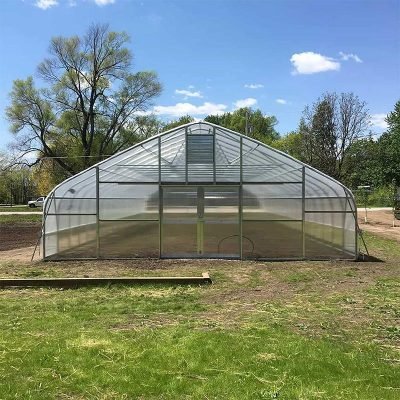





Among the many greenhouse designs available today, the Single Span Film Sawtooth Greenhouse stands out as a practical and efficient solution. It has become increasingly popular, especially for vegetable production and developing agricultural regions.
So what on earth is this greenhouse structure, and why has it gained so much attention in recent years? This article provides a comprehensive explanation, from its basic definition and structural design to its different types and the many advantages it offers to modern agricultural development.To better understand this structure in a broader context, it’s helpful to first explore what is a sawtooth greenhouse.
What on Earth is a Single Span Film Sawtooth Greenhouse?
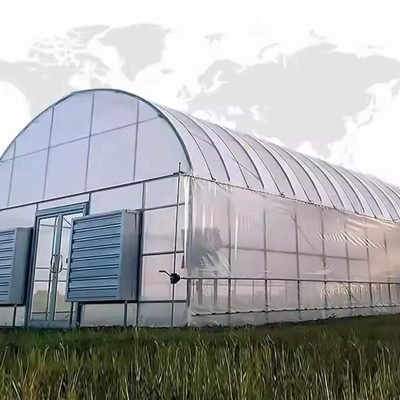
A Single Span Film Sawtooth Greenhouse is a standalone greenhouse structure. It is characterized by three core features: a single independent span, a plastic film covering, and a sawtooth-shaped roof. Each of these elements plays a crucial role in balancing cost, performance, and environmental control.
“Single span” means that the greenhouse is an independent unit rather than a connected multi-bay structure. This allows for flexible installation, easier management, and independent climate control. It is particularly useful for farms that expand in stages.
“Film” refers to the use of agricultural plastic film as the covering material. Compared with glass or polycarbonate panels, film is lighter, more affordable, and easier to install or replace, while still providing high light transmission for crop growth.
The defining feature—the sawtooth roof—gives this greenhouse its name. The roof is formed by a series of asymmetrical slopes resembling the teeth of a saw. These roof sections are usually equipped with ventilation openings at the higher points, allowing hot air to escape naturally. This makes the greenhouse especially effective in regulating temperature and humidity through natural ventilation rather than energy-intensive mechanical systems.

Unique Appearance and Ingenious Design
At first glance, the sawtooth greenhouse looks very different from traditional arched or gable-roof greenhouses. Its jagged roofline immediately draws attention, but this unique appearance is driven by function rather than aesthetics.
- Natural ventilation efficiency
The sawtooth roof is specifically designed to enhance airflow. As sunlight heats the interior, warm air rises and exits through roof vents located on the vertical or steep roof sections. Cooler outside air enters through side vents, creating a continuous natural airflow cycle. This helps prevent heat buildup and reduces humidity levels inside the greenhouse. - Improved light distribution
The angled roof surfaces allow sunlight to enter from different directions throughout the day. This reduces shading and ensures more uniform light exposure across the growing area, which is essential for consistent crop development. - Simple but robust structure
Despite its distinctive shape, the structure itself is relatively straightforward. A High Quality Single Span Film Sawtooth Greenhouse typically uses hot-dip galvanized steel frames that offer excellent strength, corrosion resistance, and long service life. - Better moisture management
The roof angles help direct rainwater and condensation away from plants, reducing the risk of dripping water and plant diseases. This contributes to a healthier growing environment.
Overall, the design reflects an intelligent use of geometry to achieve efficient climate control with minimal energy input.
Three Types with Their Own Advantages
The Sawtooth Greenhouse is highly adaptable and can be configured to suit different scales of production and farming objectives. In practice, it is commonly divided into three main types.
Small Single Span Film Sawtooth Greenhouse
A Small Single Span Film Sawtooth Greenhouse is ideal for family farms, research institutions, training centers, and growers with limited land or budget. These structures are compact, easy to construct, and simple to manage.
Key advantages include:
- Low initial investment cost
- Short construction and installation time
- Easy daily operation and maintenance
This type is often used for seedling cultivation, experimental planting, or high-value specialty crops where precise control is more important than large production volume.

Large Single Span Film Sawtooth Greenhouse
A Large Single Span Film Sawtooth Greenhouse applies the same design principles on a bigger scale. With a wider span and greater height, it provides a larger internal air volume, which helps stabilize temperature and humidity fluctuations.
Its main advantages include:
- Suitable conditions for tall crops such as tomatoes, cucumbers, and peppers
- Improved internal airflow and climate stability
- Better working space for labor and simple machinery
Large-scale units are commonly seen in agricultural demonstration zones and modern production bases.
Commercial Single Span Film Sawtooth Greenhouse
A Commercial Single Span Film Sawtooth Greenhouse is designed for professional, market-oriented farming. These greenhouses are widely used as Single Span Film Sawtooth Greenhouse For Vegetables, supplying supermarkets, wholesale markets, and food processing companies.
They often integrate systems such as drip irrigation, fertigation, shading nets, and basic automation, enabling high-efficiency, continuous production with stable quality and yield.
Many Advantages to Boost Agricultural Development
The growing popularity of this greenhouse design is closely linked to the many advantages it brings to agricultural development.
- Cost-effectiveness
Compared with glass greenhouses, film-covered structures require significantly lower investment. This reduces financial barriers and allows more farmers to adopt protected cultivation technologies. - Energy efficiency
Excellent natural ventilation minimizes the need for mechanical cooling systems, reducing electricity consumption and operating costs. This also supports low-carbon and environmentally friendly farming practices. - Wide crop adaptability
From leafy greens and herbs to fruiting vegetables, the greenhouse environment supports a wide variety of crops throughout the year. - Climate adaptability
By adjusting roof angles, vent sizes, and film types, the greenhouse can be optimized for different climatic conditions. These include warm and humid regions as well as cooler areas with appropriate insulation measures. - Scalability and flexibility
Farmers can start with one or two greenhouses and gradually expand production. Each unit remains independent, making management more flexible and reducing operational risks.
These advantages make the Single Span Film Sawtooth Greenhouse an effective tool for improving productivity, increasing farmers’ income, and promoting sustainable agricultural development.
In real-world farming, many growers choose a single span sawtooth greenhouse solution to achieve flexible installation, efficient ventilation, and cost-effective production tailored to their specific needs.
Conclusion
In summary, the Single Span Film Sawtooth Greenhouse is far more than a visually distinctive structure. It represents a thoughtful balance between simplicity and performance. Smart design helps achieve effective climate control at a reasonable cost.Whether applied as a Small Single Span Film Sawtooth Greenhouse for family farming, a Large Single Span Film Sawtooth Greenhouse for intensive cultivation, or a Commercial Single Span Film Sawtooth Greenhouse for large-scale vegetable production, this design continues to prove its value worldwide.
As agriculture faces increasing challenges related to climate change, energy costs, and food security, greenhouse structures that emphasize efficiency, adaptability, and sustainability will play a vital role. The Sawtooth Greenhouse is undoubtedly one of the most practical solutions leading this transformation.