





For commercial growers, the choice between a commercial glass greenhouse and a poly greenhouse depends on budget, crop type, climate, production goals, and long term operation plans.
In general, a poly greenhouse is more suitable for growers who need lower initial investment, faster construction, and flexible expansion. A commercial glass greenhouse is better for long term growing, high value crops, stable climate control, and professional agricultural operations.
Both greenhouse types can support vegetable production, flower cultivation, seedling propagation, and hydroponic farming. However, they perform differently in light transmission, insulation, cost, durability, maintenance, crop suitability, climate adaptability, and return on investment.
This guide compares glass greenhouses and poly greenhouses from a practical commercial growing perspective, so you can choose the structure that fits your operation.
What Is a Glass Greenhouse
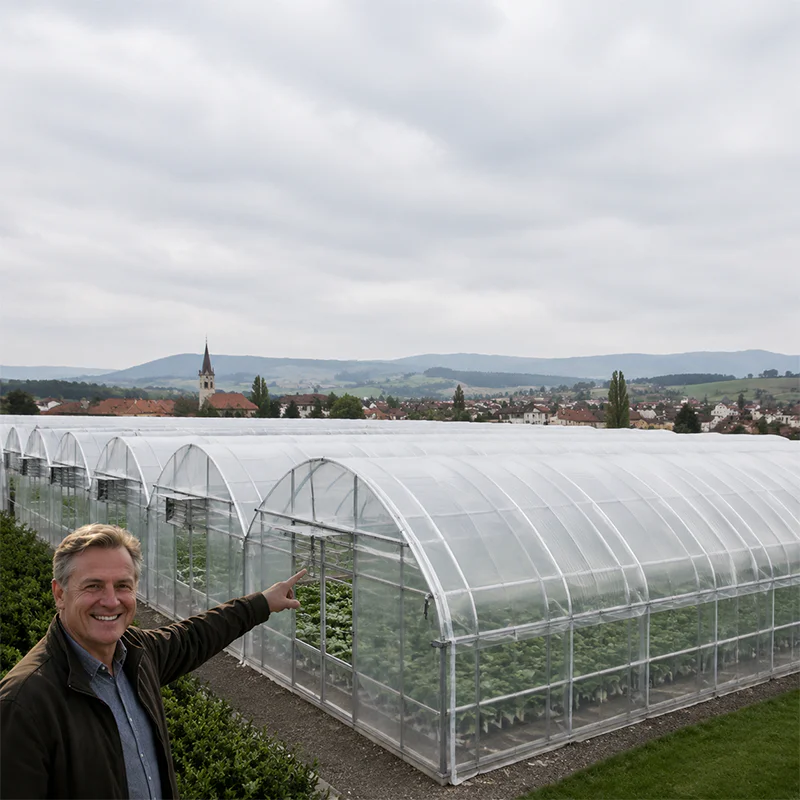
A commercial glass greenhouse is a permanent growing structure covered with glass panels, designed for long term crop production and stable climate control. It is commonly used in commercial agriculture, flower production, seedling nurseries, research facilities, and high value crop projects.
Structure and Covering Material
A glass greenhouse usually uses a hot dip galvanized steel frame or aluminum profile structure. The roof and side walls are covered with tempered glass, horticultural glass, or other greenhouse glass materials.
Commercial glass greenhouses can be equipped with ventilation systems, cooling pads, exhaust fans, shading systems, heating systems, irrigation systems, fertigation systems, and automatic climate control. This makes them suitable for growers who need stable production conditions and long term operation.
Main Advantages of Glass Greenhouses
The main advantage of a glass greenhouse is its long service life. Compared with poly film, glass does not need frequent replacement and can maintain a clean, professional appearance for many years when properly maintained.
Greenhouse glass also provides stable light transmission, which is important for crop growth, especially for flowers, seedlings, and high value crops that require consistent light conditions.A well designed glass greenhouse can help create a controlled environment for year round production.
Another advantage is the professional image. For commercial farms, agricultural parks, research centers, and premium growing facilities, a glass greenhouse often looks more permanent and high standard than a film-covered greenhouse.
Possible Limitations of Glass Greenhouses
The main limitation of a glass greenhouse is the higher initial investment. Glass panels, stronger frames, aluminum profiles, transportation, and installation usually cost more than poly greenhouse materials.
Glass is also heavier than plastic film, so the structure must be designed with stronger load-bearing capacity. Installation requires more careful handling, and damaged glass panels may cost more to replace than poly film.
For growers with limited budgets, short term planting plans, or large area expansion needs, a glass greenhouse may not always be the most economical choice.
Best Applications for Glass Greenhouses
A commercial glass greenhouse is suitable for long term growing projects, high value crops, flowers, seedlings, research production, agricultural demonstration projects, and farms that require stable climate control.
It is also suitable for growers who want a durable greenhouse structure with a professional appearance and a longer covering life.
What Is a Poly Greenhouse
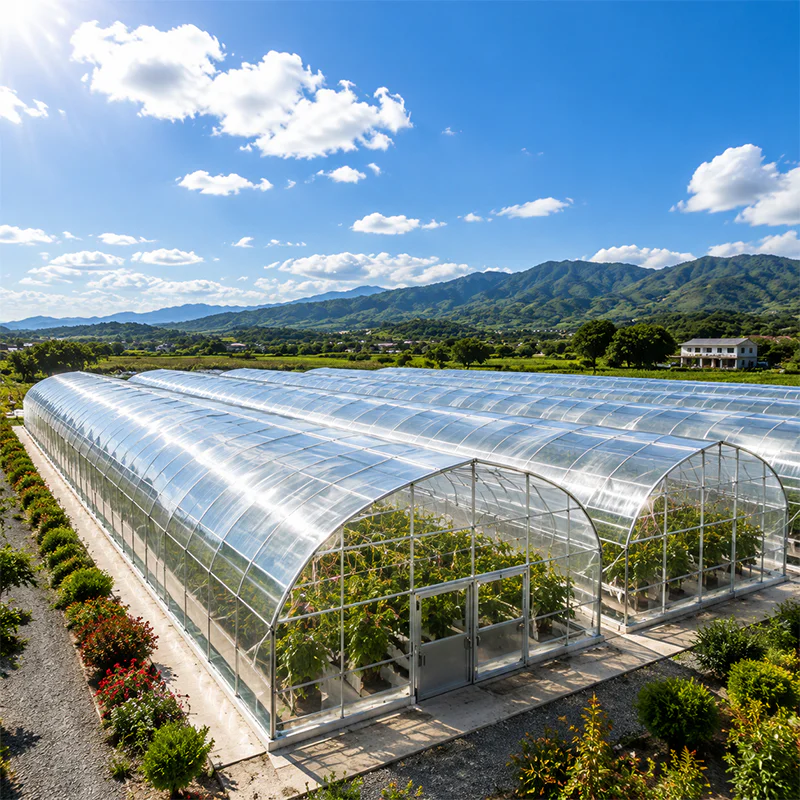
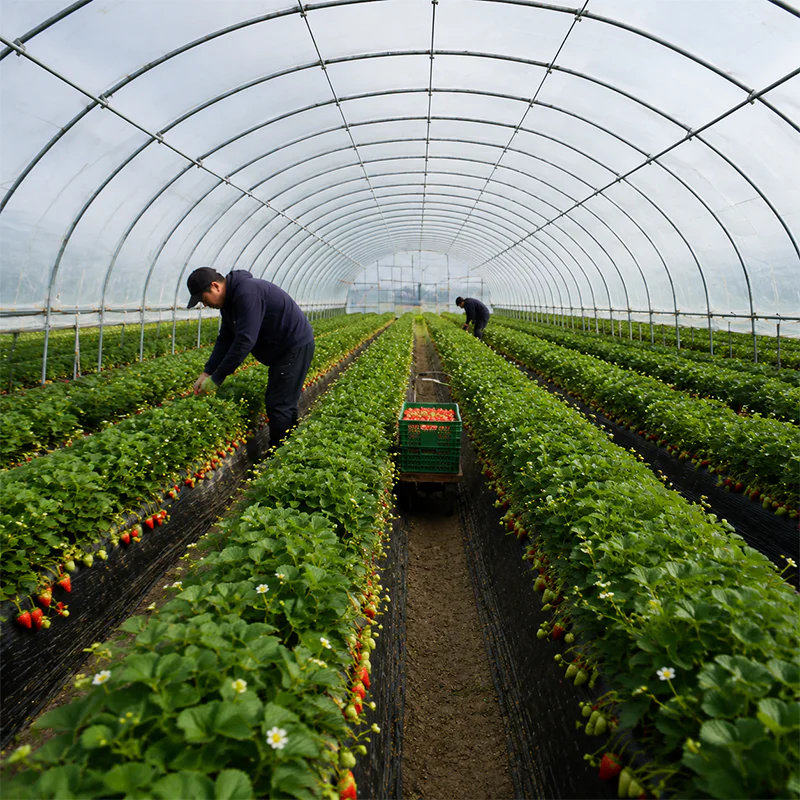
A poly greenhouse is a greenhouse covered with polyethylene film, often called poly film. In this article, “poly greenhouse” refers to a plastic film greenhouse, not a polycarbonate panel greenhouse.
Poly greenhouses are widely used in commercial vegetable farming, hydroponic production, flower growing, seedling cultivation, and seasonal crop production because they are cost effective and flexible.
Structure and Covering Material
A poly greenhouse usually uses a hot dip galvanized steel frame with one or two layers of polyethylene film. Some projects use single layer film, while others use double layer inflated film for better insulation.
Depending on the growing needs, a poly greenhouse can include side ventilation, roof ventilation, insect nets, shade systems, cooling pads, exhaust fans, irrigation systems, and hydroponic systems.
Main Advantages of Poly Greenhouses
The biggest advantage of a poly greenhouse is lower initial cost. Compared with a glass greenhouse, it usually requires less investment, which makes it attractive for growers who want to start production quickly or expand planting area.
Poly greenhouses are also faster to install. The covering film is lightweight, easier to transport, and easier to replace. This makes poly greenhouses practical for large area vegetable production, seasonal planting, and projects that may need future expansion.
Another advantage is flexibility. Growers can choose different film types, greenhouse sizes, ventilation designs, and internal growing systems according to crop and climate requirements.
Possible Limitations of Poly Greenhouses
The main limitation of a poly greenhouse is that the covering film has a shorter service life than glass. Film life depends on film quality, UV exposure, wind, weather conditions, and maintenance.
Poly greenhouses may also require more attention to film tension, repair, and replacement. In strong wind, snow, or harsh weather areas, the structure and film fixing system must be carefully designed.
Although poly greenhouses are cost effective, they usually do not provide the same long term appearance, covering durability, or premium image as glass greenhouses.
Best Applications for Poly Greenhouses
Poly greenhouses are suitable for growers who need lower investment, fast construction, flexible expansion, and large planting areas. They are often used for vegetables, leafy greens, tomatoes, cucumbers, peppers, strawberries, hydroponic crops, and seasonal production.
For many commercial farms, a poly greenhouse provides a practical balance between cost and production capacity.

Glass Greenhouse vs Poly Greenhouse Key Differences
Both greenhouse types can support commercial growing, but the best choice depends on how each structure performs under real operating conditions.
Light Transmission and Plant Performance
Glass greenhouses usually provide stable and clear light transmission. This helps crops receive consistent natural sunlight, which is useful for flowers, seedlings, and high value crops that require reliable light conditions.
Poly greenhouses can also provide good light transmission, especially when using high quality greenhouse film. Some poly films are designed for light diffusion, anti drip performance, UV resistance, or thermal insulation.
For growers, the key is not only how much light enters the greenhouse, but also how evenly the light is distributed. Diffused light can reduce direct light stress and help improve light distribution inside the crop canopy.
Insulation Heating and Energy Costs
A controlled environment glass greenhouse can be equipped with heating systems, thermal screens, and automatic climate control.However, without proper insulation design, glass may lose heat in cold seasons.
A poly greenhouse can use single layer film, double layer inflated film, or thermal film to improve insulation. Double layer inflated film is often used in colder regions because the air layer helps reduce heat loss.
In cold climates, heating cost can become a major part of long term operating expenses. Growers should consider not only the greenhouse price, but also insulation performance, heating demand, and energy cost.
Durability Weather Resistance and Maintenance
Glass has a long covering life and does not need to be replaced as often as poly film. A properly designed glass greenhouse can be a durable solution for long term commercial operation.
Poly film has a shorter life and needs replacement after a certain period. The replacement cycle depends on film quality, sunlight intensity, wind exposure, and local climate conditions.
Weather resistance depends on engineering design. A glass greenhouse requires a strong frame because glass is heavier. A poly greenhouse needs proper film locking systems, strong steel structure, and suitable spacing to handle wind or snow conditions.
Initial Cost Lifespan and Return on Investment
A glass greenhouse usually has a higher initial cost. This includes glass panels, stronger structure, installation, and often more advanced climate systems. However, for long term and high value projects, the longer service life and stable operation may support better long term value.
A poly greenhouse usually has a lower initial cost and faster payback potential, especially for large scale vegetable production or projects with controlled budgets. However, growers should include film replacement and maintenance in the long term cost calculation.
The better return on investment depends on crop value, production stability, market price, climate, labor cost, and how long the grower plans to operate the facility.
Installation Time and Expansion Flexibility
Glass greenhouses usually take more time to install because the covering material is heavier and requires careful handling.
Poly greenhouses are usually faster to build. They are also easier to expand in phases. For growers who want to start production quickly or add more growing area later, a poly greenhouse can be more flexible.

Glass Greenhouse vs Poly Greenhouse Comparison Table
| عنصر المقارنة | دفيئة زجاجية | Poly Greenhouse |
|---|---|---|
| التكلفة الأولية | أعلى | أقل |
| مواد التغطية | Glass panels | Polyethylene film |
| عمر الخدمة | Longer covering life | Film needs replacement over time |
| انتقال الضوء | Stable and clear | Good, depending on film quality |
| Insulation | Needs thermal screen or heating design | Can use single or double layer film |
| التحكم في المناخ | Suitable for advanced control systems | Can be basic or automated |
| الصيانة | Lower covering replacement frequency | Film repair and replacement needed |
| Installation Time | Longer | Faster |
| المحاصيل المناسبة | Flowers, seedlings, high value crops, vegetables | Vegetables, hydroponic crops, seasonal crops, large area farming |
| المناخ المناسب | Long term projects with proper engineering | Flexible for many climates with correct design |
| Long Term ROI | Strong for premium long term projects | Strong for cost controlled production |
When Is a Glass Greenhouse the Better Choice
A glass greenhouse is not always necessary for every farm. However, for long term commercial operations, it becomes a strong choice when the project requires durability, stable production, and long term value.
Long Term Commercial Growing Projects
If your project is planned for long term operation, a glass greenhouse can be a better investment. The covering material has a longer service life, and the structure is suitable for high standard commercial production.
For farms that want to build a permanent growing facility, glass can reduce the need for frequent covering replacement compared with poly film.
High Value Crops and Premium Production
A glass greenhouse for commercial farming is often suitable for high value crops such as flowers, seedlings, specialty vegetables, and premium horticultural crops. These crops usually require stable light, temperature, humidity, and growing conditions.
When crop value is high, investing in a more stable and durable greenhouse environment may be easier to justify.
Projects Requiring Stable Climate Control
High tech glass greenhouses are commonly used with advanced systems such as automatic ventilation, shading, heating, cooling, irrigation, fertigation, and environmental sensors.
If your operation requires precise climate control, year round production, or controlled growing conditions, a glass greenhouse can provide a strong foundation for these systems.
Farms Focused on Professional Appearance and Durability
For agricultural parks, research centers, commercial demonstration farms, and premium production facilities, appearance can also be important. A glass greenhouse gives a clean and professional look, which can support branding, customer visits, and long term project value.

When Is a Poly Greenhouse the Better Choice
A poly greenhouse is a practical choice for many growers, especially when budget, installation speed, and expansion flexibility are important.
مشاريع الميزانية المنخفضة
If your main priority is controlling initial investment, a poly greenhouse is usually more suitable. It allows growers to build a larger planting area at a lower cost compared with a glass greenhouse.
This is especially helpful for new growers or projects that need to test production before making a larger investment.
Fast Installation and Expansion
Poly greenhouses are easier and faster to install. The covering film is lightweight, and the structure can be designed for phased expansion.
For farms that need quick construction or seasonal production, this flexibility can be very useful.
Seasonal or Short to Medium Term Growing
If the greenhouse will mainly be used for seasonal production, temporary planting, or short to medium term growing, a poly greenhouse may be more cost effective.
The lower investment makes it easier to adjust production plans according to market demand.
Large Area Vegetable Production
For large area vegetable production, poly greenhouses are widely used because they balance cost and production capacity. Crops such as tomatoes, cucumbers, peppers, lettuce, and leafy greens can be grown successfully in poly greenhouses when ventilation, irrigation, and climate systems are properly designed.

Which Greenhouse Is Better for Different Crops
Crop type is one of the most important factors when choosing between a glass greenhouse and a poly greenhouse.
الخضروات
For common vegetables such as tomatoes, cucumbers, peppers, lettuce, and leafy greens, a poly greenhouse is often a cost effective option. It provides large growing space and can be equipped with ventilation, cooling, shading, and irrigation systems.
A glass greenhouse can also be used for vegetables, especially when the grower needs year round production, higher automation, or a more stable growing environment.
الزهور
Flowers often require stable light, temperature, humidity, and appearance quality. For high value flower production, a glass greenhouse can be a strong choice because it supports long term operation and advanced climate control.
Poly greenhouses can also be used for flowers, especially where the project budget is limited or production is seasonal.
المحاصيل المائية
Both glass greenhouses and poly greenhouses can support hydroponic farming. A glass greenhouse is suitable for high standard hydroponic projects that require stable climate control and long term investment.
A poly greenhouse is often used for NFT systems, DWC systems, grow bags, substrate cultivation, and leafy green production because it offers lower construction cost and flexible layout.
الشتلات
Seedlings need stable temperature, humidity, light, and ventilation. A glass greenhouse can be suitable for professional nurseries and seedling production facilities that require consistent conditions.
Poly greenhouses can also work well for seedlings when equipped with seedbeds, misting systems, shading systems, and proper ventilation.
High Value Crops
For high value crops, the best greenhouse depends on crop price, production cycle, climate requirements, and expected return. If the crop requires stable conditions and has strong market value, a glass greenhouse may be worth the higher investment.
If the grower needs to control cost while maintaining commercial production, a poly greenhouse may still be a practical option.
Which Greenhouse Is Better for Different Climates
Climate has a direct impact on greenhouse design. The same greenhouse structure may perform differently in hot, cold, windy, or snowy regions.
Hot and Humid Climates
In hot and humid climates, ventilation and cooling are critical. A poly greenhouse with roof ventilation, side ventilation, shade systems, cooling pads, and exhaust fans can be a practical choice.
A glass greenhouse can also work in hot climates, but it needs strong cooling and shading design to reduce heat buildup and control humidity.
Cold Climates
In cold climates, insulation and heating cost are major concerns. A glass greenhouse can be used for long term production, but it should include heating systems, thermal screens, and proper insulation planning.
A poly greenhouse can use double layer inflated film to improve insulation. For cold regions, growers should carefully consider heating demand, snow load, and operating cost before choosing the structure.
Windy Areas
In windy areas, the greenhouse structure must be designed according to local wind conditions. A glass greenhouse needs a strong frame and secure glass installation.
A poly greenhouse needs strong film locking systems, proper foundation, and reinforced steel structure. Poor film fixing can cause damage in strong winds, so engineering design is very important.
Snowy Areas
In snowy areas, snow load should be considered from the beginning of the design. A glass greenhouse requires a strong roof structure because glass is heavy and snow adds extra load.
A poly greenhouse can also be designed for snowy regions, but it needs proper arch design, column spacing, roof slope, and structural reinforcement. In heavy snow regions, heating and snow removal planning may also be necessary.
Tropical and Subtropical Regions
In tropical and subtropical regions, poly greenhouses are often used because they are cost effective and flexible. Growers usually focus on ventilation, rain protection, insect control, shading, and humidity management.
Glass greenhouses can also be used in these regions, especially for high value crops or advanced commercial projects. However, cooling design and cost should be carefully evaluated.
How to Choose the Right Greenhouse for Your Operation
The right greenhouse is not simply the most expensive structure or the lowest cost option. It should match your crop, climate, budget, and long term business plan.
الميزانية
If you need to control initial investment, a poly greenhouse is usually more practical. If your project has a larger budget and long term production goals, a glass greenhouse may provide better long term value.
نوع المحصول
Vegetables, leafy greens, and seasonal crops can often grow well in poly greenhouses. Flowers, seedlings, and high value crops may benefit from the stable environment and professional appearance of a glass greenhouse.
المناخ المحلي
Hot climates need ventilation, cooling, and shading. Cold climates need insulation and heating. Windy and snowy climates need stronger structural design.
Before confirming the greenhouse type, growers should evaluate local temperature, wind speed, snow load, rainfall, humidity, and sunlight conditions.
مواد التغطية
Glass offers durability and long covering life. Poly film offers lower cost and flexibility. The best covering material depends on how long you plan to use the greenhouse, how much maintenance you can accept, and what crops you want to grow.
Automation Requirements
If your project requires advanced automation, a glass greenhouse can provide a strong base for climate control systems. However, poly greenhouses can also support automation, including ventilation, cooling, irrigation, fertigation, and shading systems.
The automation level should match crop value and expected return.
Long Term Operation Cost
Initial cost is only one part of the total investment. Growers should also consider heating, cooling, film replacement, glass replacement, irrigation, energy use, labor, and maintenance.
A glass greenhouse may cost more at the beginning, but it can reduce covering replacement frequency. A poly greenhouse costs less to build, but the film will need replacement over time.
Return on Investment
Return on investment depends on crop yield, crop value, market price, production stability, energy cost, and maintenance cost.
A poly greenhouse may offer faster payback for large area vegetable production. A glass greenhouse may offer stronger long term value for high value crops, stable production, and professional commercial projects.

Aurlant Glass Greenhouse Solutions
Aurlant provides customized greenhouse solutions for commercial growers with different crops, climates, budgets, and production goals. For growers considering a commercial glass greenhouse, the most important step is to design the structure and systems according to actual project conditions.
Commercial Glass Greenhouse Structure Design
Aurlant can design commercial glass greenhouse structures based on project size, local climate, crop type, wind load, snow load, ventilation needs, and foundation conditions.
A suitable structure helps improve durability, safety, and long term operation performance.
Ventilation Cooling Heating and Shading Systems
A commercial greenhouse needs more than a frame and covering material. Proper ventilation, cooling, heating, and shading systems are important for crop health and production stability.
Aurlant can provide roof ventilation, side ventilation, cooling pads, exhaust fans, internal shading, external shading, heating systems, and control systems according to the project needs.
Irrigation and Hydroponic System Integration
For hydroponic farming, irrigation and nutrient management should be planned together with the greenhouse structure. Aurlant can help integrate irrigation systems, fertigation systems, NFT systems, DWC systems, grow bags, seedbeds, and other growing systems.
This can improve space use, water management, nutrient delivery, and daily operation efficiency.
Project Support from Design to Installation
Aurlant supports greenhouse projects from design and product selection to production and installation guidance. Growers can provide project location, greenhouse size, crop type, climate data, and budget range, so the greenhouse plan can better match real growing needs.
الأسئلة الشائعة
Is a glass greenhouse better than a poly greenhouse
A glass greenhouse is better for long term commercial projects, high value crops, stable climate control, and professional growing facilities. A poly greenhouse is better for lower budget projects, fast construction, flexible expansion, and large area vegetable production.
What is the difference between a glass greenhouse and a poly greenhouse
The main difference is the covering material. A glass greenhouse uses glass panels, while a poly greenhouse uses polyethylene film. Glass offers longer covering life and a more professional appearance, while poly film offers lower cost and easier installation.
Is a glass greenhouse worth the higher cost
A glass greenhouse can be worth the higher cost if the project requires long term use, stable climate control, high value crop production, or a professional commercial image. For short term or low budget projects, a poly greenhouse may be more practical.
How long does a glass greenhouse last
A well designed glass greenhouse can be used for many years with proper maintenance. The actual service life depends on structural design, glass quality, local climate, installation quality, and maintenance.
Which crops are suitable for a glass greenhouse
Glass greenhouses are suitable for flowers, seedlings, high value vegetables, hydroponic crops, research crops, and premium commercial production. The final choice should depend on crop value, climate requirements, and investment plan.
Which greenhouse is better for hot climates
For hot climates, both greenhouse types need good ventilation, shading, and cooling systems. A poly greenhouse is often more cost effective, while a glass greenhouse can work well if the cooling and shading design is properly planned.
Can a glass greenhouse be used for hydroponic farming
Yes. A glass greenhouse can be used for hydroponic farming, including NFT systems, DWC systems, substrate cultivation, grow bags, and seedling systems. The greenhouse design should consider water supply, drainage, fertigation, ventilation, cooling, and crop layout.
الخاتمة
Poly greenhouses and glass greenhouses both have clear advantages. A poly greenhouse is suitable for growers who need lower investment, fast construction, flexible expansion, and large area crop production. It is a practical option for many vegetable, hydroponic, and seasonal growing projects.
A glass greenhouse is more suitable for long term investment, high value crops, stable climate control, and high standard commercial growing. It offers a durable covering, professional appearance, and strong potential for advanced greenhouse systems.
The best choice depends on your budget, crop type, local climate, automation needs, maintenance plan, and expected return on investment. For growers planning a long term commercial greenhouse project, Aurlant can provide customized glass greenhouse solutions based on your operation requirements.