




For commercial growers, choosing between a glass greenhouse and a plastic multi span greenhouse is not only a matter of appearance. It directly affects the initial investment, service life, light transmission, climate control, crop performance, maintenance cost, and long term return on investment.
A glass greenhouse is often considered a high end and long lasting structure, while a plastic multi span greenhouse is usually more affordable, flexible, and easier to adapt to different farming projects. Both options can support commercial vegetable production, flower cultivation, seedling propagation, and hydroponic farming, but they are suitable for different budgets, climates, and business goals.
This guide compares glass greenhouses and plastic multi span greenhouses from a practical commercial farming perspective, helping growers choose the right structure based on real project needs.
What Is a Glass Greenhouse
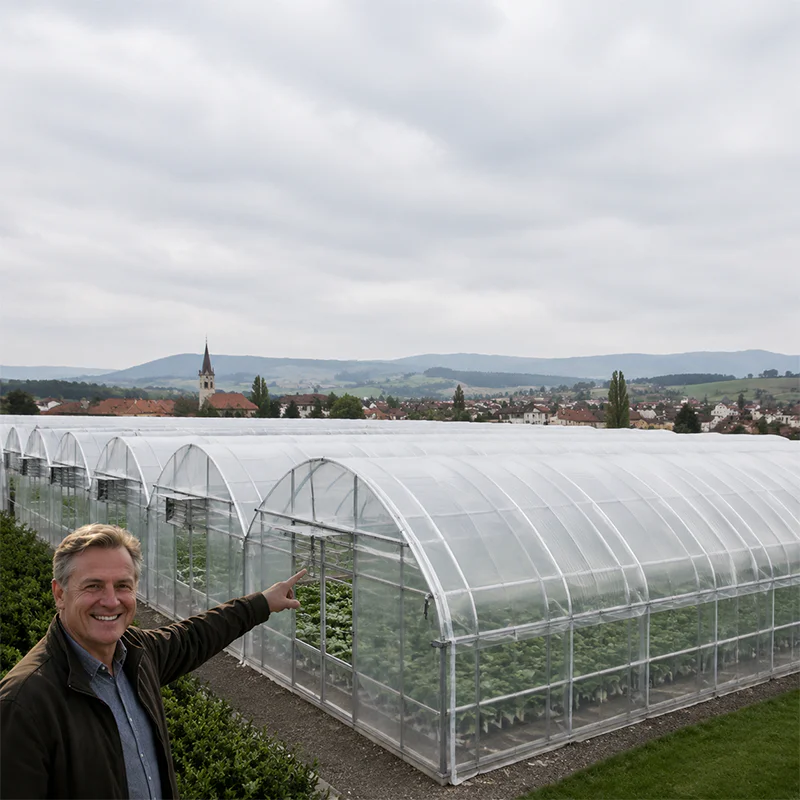
A glass greenhouse is a permanent greenhouse structure covered with glass panels. It is commonly used in modern commercial agriculture, flower production, research facilities, seedling nurseries, and high value crop cultivation.
Structure and Covering Material
A glass greenhouse usually uses a hot dip galvanized steel frame or aluminum profile structure combined with tempered glass or horticultural glass. The roof and side walls are covered with glass panels, allowing natural sunlight to enter the growing area.
Many commercial glass greenhouses can be equipped with ventilation systems, shading systems, cooling pads, exhaust fans, heating systems, irrigation systems, and automatic climate control. This makes them suitable for growers who need stable production conditions and long term operation.
Main Advantages of Glass Greenhouses
The biggest advantage of a glass greenhouse is durability. Compared with plastic film, glass has a much longer service life and does not need frequent replacement. For long term commercial projects, this can reduce the cost and labor involved in replacing covering materials.
Glass also has good light transmission, which is important for crops that require stable natural sunlight. A well designed glass greenhouse can provide a clean, professional appearance and is often used for high standard agricultural projects.
Another advantage is structural stability. When properly engineered, a glass greenhouse can be designed for strong wind, snow load, and long term outdoor use. This makes it suitable for regions where growers need a more permanent greenhouse solution.
Limitations of Glass Greenhouses
The main limitation of a glass greenhouse is the higher initial investment. Glass panels, aluminum profiles, stronger structural design, and installation requirements usually make the total project cost higher than a plastic multi span greenhouse.
Glass is also heavier than plastic film, so the frame structure must be stronger. Transportation and installation require more careful handling. If glass panels are damaged, replacement may also be more expensive than replacing greenhouse film.
For growers with limited budgets or short term planting plans, a glass greenhouse may not always be the most cost effective choice.
Best Applications for Glass Greenhouses
Glass greenhouses are suitable for projects that require long term use, high appearance standards, and stable environmental control. They are often used for flower cultivation, seedling production, research projects, high value vegetables, and commercial farms with advanced automation systems.
For investors who plan to operate a greenhouse for many years and want a durable structure with a professional image, a glass greenhouse can be a strong option.

What Is a Plastic Multi Span Greenhouse
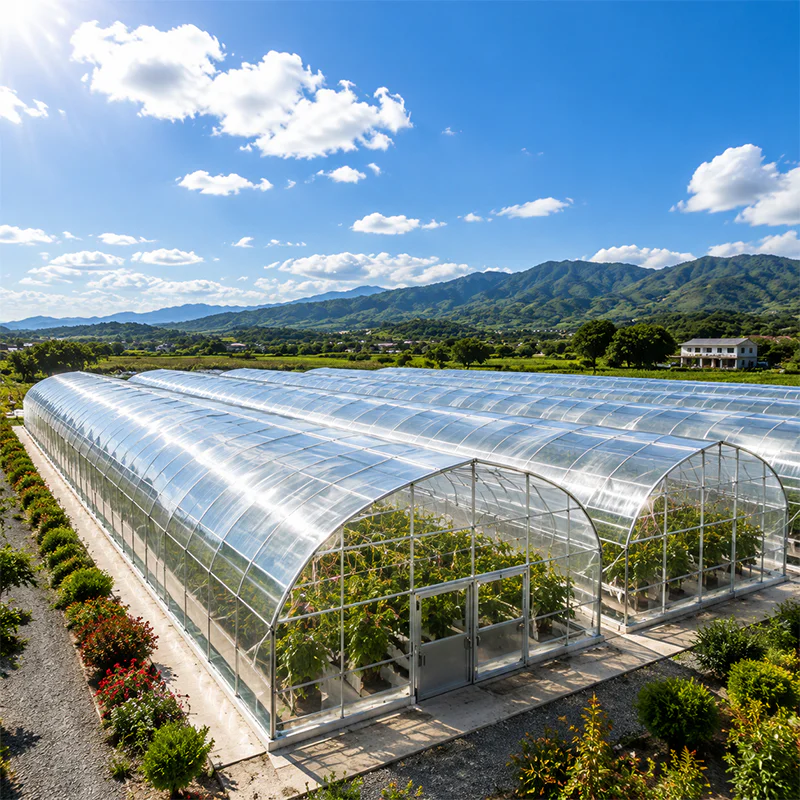
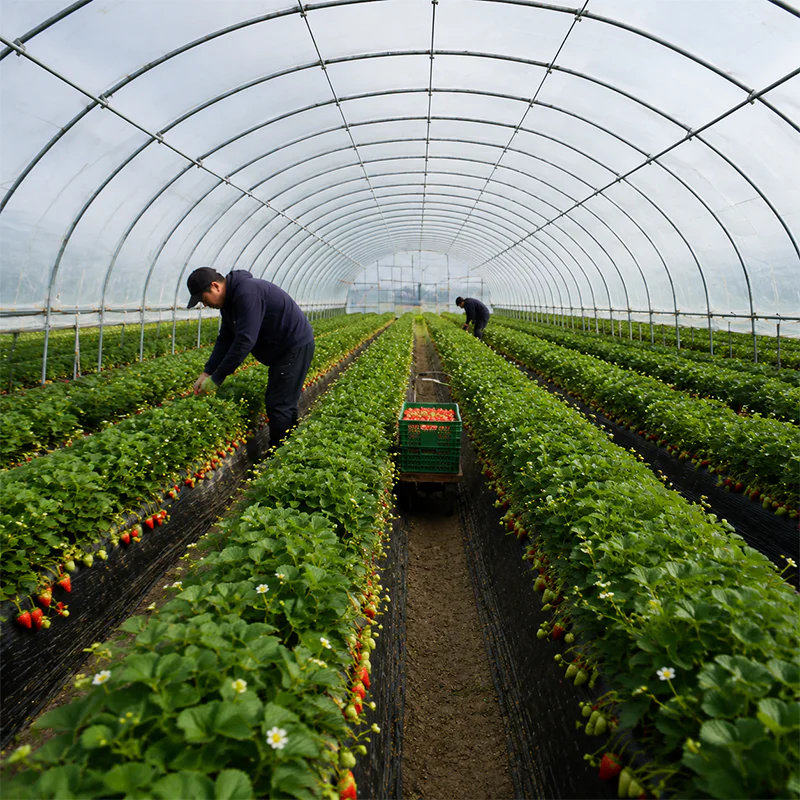
A plastic multi span greenhouse is a connected greenhouse structure covered with plastic film, such as PE film, PO film, or other agricultural greenhouse films. It is widely used in commercial farming because of its lower cost, flexible design, and wide application range.
A multi span greenhouse, also known as a multi-span greenhouse or multispan greenhouse, connects multiple greenhouse spans together to create a larger growing area. This structure is suitable for commercial scale production and can be customized according to crop type, local climate, and budget.
Structure and Covering Material
A plastic multi span greenhouse usually uses a hot dip galvanized steel frame and agricultural plastic film as the covering material. Depending on the project, it can include roof ventilation, side ventilation, insect nets, shading systems, cooling systems, irrigation systems, and hydroponic systems.
The covering film can be selected according to the local climate and crop requirements. For example, some growers may choose high light transmission film, anti drip film, diffused film, or thermal insulation film.
Main Advantages of Plastic Multi Span Greenhouses
The biggest advantage of a plastic multi span greenhouse is cost effectiveness. Compared with a glass greenhouse, it usually requires a lower initial investment, making it more suitable for growers who want to expand production while controlling project cost.
Plastic multi span greenhouses are also flexible. They can be designed for vegetables, flowers, seedlings, hydroponic crops, berries, and other agricultural applications. The size, span width, height, ventilation method, and internal systems can be customized.
Another advantage is faster installation. Because plastic film is lighter than glass, the structure is easier to transport and install. This is helpful for projects that need quick construction or phased expansion.
Limitations of Plastic Multi Span Greenhouses
The main limitation is that plastic film has a shorter service life than glass. Depending on film quality, sunlight intensity, wind conditions, and local climate, the covering film may need replacement after several years.
Plastic multi span greenhouses may also require more attention to film tension, repair, and maintenance. In areas with strong wind, heavy snow, or extreme weather, the structure must be carefully designed to meet local load requirements.
Although plastic film greenhouses are practical and economical, they may not provide the same high end appearance or long term covering life as glass greenhouses.
Best Applications for Plastic Multi Span Greenhouses
Plastic multi span greenhouses are suitable for vegetable production, hydroponic farming, seedling cultivation, flower growing, and commercial farms that need large planting areas at a reasonable cost.
For growers who want a practical greenhouse solution with flexible design and good return on investment, a plastic multi span greenhouse is often the better choice.

Glass Greenhouse vs Plastic Multi Span Greenhouse Key Differences
Both greenhouse types can support commercial farming, but their performance differs in several important areas.
প্রাথমিক বিনিয়োগ খরচ
A glass greenhouse usually requires a higher initial investment because of the glass covering, stronger frame structure, and more complex installation requirements. It is more suitable for growers who have a higher budget and a long term operation plan.
A plastic multi span greenhouse is usually more economical. It allows growers to build a larger planting area with a lower investment. For many commercial vegetable farms and hydroponic projects, this makes the plastic multi span greenhouse a more practical starting point.
Service Life and Durability
Glass has a long service life and does not need to be replaced as frequently as plastic film. If the structure is properly designed and maintained, a glass greenhouse can serve for many years.
Plastic film has a shorter service life. The frame of a plastic বহু-স্প্যান গ্রীনহাউস can be durable, but the covering film will need replacement over time. The actual replacement cycle depends on the film type, UV resistance, local climate, and maintenance quality.
Light Transmission
Glass usually provides stable light transmission and is suitable for crops that need consistent natural light. It also gives the greenhouse a clean and transparent appearance.
Plastic film can also provide good light transmission, especially when high quality greenhouse film is used. Some films are designed to diffuse sunlight, reduce crop stress, and improve light distribution inside the greenhouse. For many commercial crops, plastic film can meet normal growing requirements.
তাপ নিরোধক
Glass greenhouses can be equipped with insulation screens, heating systems, and climate control equipment, but glass itself may lose heat if no additional insulation system is used.
Plastic multi span greenhouses can use single layer film, double layer inflated film, or thermal insulation film depending on the climate. In cold areas, growers should pay special attention to insulation design, heating capacity, and energy cost.
Climate Control Performance
Both glass greenhouses and plastic multi span greenhouses can be equipped with climate control systems. The difference is usually related to investment level and project design.
Glass greenhouses are often used with advanced automation systems, including automatic ventilation, shading, cooling, heating, irrigation, and environmental sensors.
Plastic multi span greenhouses can also support automatic systems, but many growers choose different levels of automation based on budget. For example, a basic vegetable greenhouse may only use natural ventilation and irrigation, while a hydroponic greenhouse may include cooling pads, fans, shading, fertigation, and environmental control.
Wind and Snow Resistance
Wind and snow resistance depend more on structural engineering than covering material alone. A glass greenhouse usually needs a stronger frame because the covering material is heavier.
A plastic multi span greenhouse can also be designed for windy or snowy areas, but the steel structure, column size, arch spacing, foundation, and film fixing system must match local climate requirements.
For any commercial greenhouse project, growers should provide local wind speed, snow load, temperature range, and installation location before confirming the design.
Maintenance Cost
Glass greenhouses generally have lower covering replacement frequency, but if glass panels are damaged, the replacement cost may be higher.
Plastic multi span greenhouses usually have lower repair costs, but the film needs periodic replacement. Growers should include film replacement in their long term operation budget.
Installation Time
A glass greenhouse usually requires more installation time because glass panels are heavier and need careful handling.
A plastic multi span greenhouse is usually faster to install. This is one reason why it is popular for commercial farms that need quick construction, seasonal planting, or phased expansion.
Comparison Table Glass Greenhouse vs Plastic Multi Span Greenhouse
| তুলনা আইটেম | কাঁচের গ্রীনহাউস | Plastic Multi Span Greenhouse |
|---|---|---|
| প্রাথমিক খরচ | উচ্চতর | নিম্ন |
| আবরণ সামগ্রী | Glass panels | PE film, PO film, or agricultural plastic film |
| Service Life | Long covering life | Film needs replacement after several years |
| Light Transmission | Stable and clear | Good, depending on film type |
| Appearance | High end and professional | Practical and commercial |
| Structure Requirement | Stronger frame required | Flexible steel frame design |
| Installation Speed | Slower | Faster |
| রক্ষণাবেক্ষণ | Lower covering replacement frequency | Lower repair cost but film replacement needed |
| জলবায়ু নিয়ন্ত্রণ | Suitable for advanced automation | Can be basic or automated |
| সেরা জন্য | Long term high standard projects | Cost effective commercial farming |
| ROI Potential | Good for long term premium projects | Good for practical large scale production |
Which Greenhouse Is Better for Different Crops
Different crops have different requirements for light, temperature, humidity, growing space, and automation. The best greenhouse choice should match the crop’s production model.
শাকসবজি
For common vegetables such as tomatoes, cucumbers, peppers, lettuce, and leafy greens, a plastic multi span greenhouse is often a cost effective choice. It provides enough growing space and can be equipped with ventilation, cooling, shading, irrigation, and hydroponic systems.
A glass greenhouse can also be used for vegetables, especially high value crops or projects that require advanced environmental control. However, for many vegetable growers, the higher investment may not be necessary unless the project has a premium production target.
ফুল
Glass greenhouses are often suitable for high value flowers, ornamental plants, and nursery projects that require stable light, good appearance, and long term operation.
Plastic multi span greenhouses can also be used for flower production, especially when growers need larger areas and lower construction costs. The final choice depends on flower type, market positioning, and climate control requirements.
হাইড্রোপনিক ফসল
Both greenhouse types can support hydroponic farming. A plastic multi span greenhouse is widely used for hydroponic vegetables, NFT systems, DWC systems, vertical systems, and substrate cultivation because it offers good space efficiency and lower investment.
A glass greenhouse is more suitable for high standard hydroponic projects with advanced automation, stable climate control, and long term investment planning.
চারা
Seedling production requires stable temperature, humidity, ventilation, and light management. Glass greenhouses are suitable for professional nursery projects that require high precision and long term operation.
Plastic multi span greenhouses are also widely used for seedling production, especially when combined with seedbeds, misting systems, shading systems, and ventilation systems.
High Value Crops
For high value crops, the decision should be based on expected profit, climate control needs, and long term operation cost. If the crop requires a highly stable environment and the project has sufficient budget, a glass greenhouse may be suitable.
If the grower wants to balance investment and production efficiency, a plastic multi span greenhouse may offer better flexibility and faster payback potential.
Which Greenhouse Is Better for Different Climates
Local climate is one of the most important factors in greenhouse selection. A greenhouse that works well in one region may not be suitable for another region without design adjustments.
Hot and Humid Areas
In hot and humid areas, ventilation and cooling are more important than covering material alone. A plastic multi span greenhouse with roof ventilation, side ventilation, insect nets, shading systems, cooling pads, and exhaust fans can be a practical choice.
Glass greenhouses can also be used in hot climates, but the cooling system must be carefully designed to prevent overheating and high humidity problems.
Cold Areas
In cold regions, growers need to consider insulation, heating cost, snow load, and energy efficiency. A glass greenhouse can be used for long term production if equipped with heating and insulation systems.
A plastic multi span greenhouse can also be designed for cold climates using double layer inflated film, thermal screens, heating systems, and stronger steel structures. For cold area projects, it is important to calculate heating demand before construction.
Windy Areas
For windy regions, the key is structural strength. Both glass greenhouses and plastic multi span greenhouses can be designed for wind resistance, but the design must match local wind speed.
Plastic multi span greenhouses need strong film locking systems, proper foundation, suitable column spacing, and reinforced structure. Glass greenhouses need strong frames and safe glass installation to handle wind pressure.
Snowy Areas
In snowy areas, snow load is a major design factor. A glass greenhouse must have a strong roof structure because glass is heavy and snow adds extra load.
A plastic multi span greenhouse can be designed with stronger arches, closer spacing, larger columns, and proper roof slope. In heavy snow areas, heating and snow removal planning may also be necessary.
Tropical and Subtropical Regions
In tropical and subtropical regions, plastic multi span greenhouses are often used because they are cost effective and adaptable. Growers usually focus on ventilation, shading, rain protection, insect control, and humidity management.
Glass greenhouses can also be used, but the higher cost must be justified by crop value, project positioning, or long term production goals.

How to Choose the Right Greenhouse for Your Project
There is no single greenhouse type that is best for every grower. The right choice depends on your project conditions and business goals.
বাজেট
If your budget is limited and you want to build a larger planting area, a plastic multi span greenhouse is usually more practical.
If your budget is higher and you want a long term, high standard greenhouse with strong appearance and durable covering, a glass greenhouse may be worth considering.
ফসলের ধরন
Leafy vegetables, cucumbers, tomatoes, peppers, strawberries, and many hydroponic crops can grow well in a plastic multi span greenhouse when the internal system is properly designed.
High value flowers, seedlings, research crops, and premium commercial crops may benefit from a glass greenhouse, especially when environmental control is important.
স্থানীয় জলবায়ু
Hot areas need strong ventilation and cooling. Cold areas need insulation and heating. Windy and snowy areas need stronger structures.
Before choosing a greenhouse, growers should evaluate local temperature, wind speed, rainfall, snow load, humidity, and sunlight conditions.
আবরণ সামগ্রী
Glass is durable and long lasting, but it is more expensive and heavier.
Plastic film is lighter, more affordable, and flexible, but it needs replacement over time. For plastic multi span greenhouse projects, choosing the right film is very important. Growers can consider anti drip film, diffused film, UV resistant film, thermal film, or double layer inflated film according to project needs.
Automation Requirements
If your project needs advanced automation, both greenhouse types can be equipped with automatic ventilation, shading, cooling, irrigation, fertigation, and climate control systems.
However, the automation level should match the crop value and expected return. A simple vegetable farm may not need the same automation level as a high value hydroponic or flower project.
Long Term Operation Cost
The lowest construction cost is not always the lowest total cost. Growers should also consider film replacement, heating cost, cooling cost, labor, maintenance, irrigation, and energy consumption.
A glass greenhouse may have higher initial cost but longer covering life. A plastic multi span greenhouse may have lower initial cost but requires film replacement after several years.
Return on Investment
Return on investment depends on crop value, yield, market price, production stability, and operating cost. For many commercial farms, a plastic multi span greenhouse offers a good balance between investment and production capacity.
For premium projects with long term operation plans, a glass greenhouse may provide stronger value over time.
Aurlant Customized Greenhouse Solutions
Aurlant provides customized greenhouse solutions for commercial growers with different crops, climates, budgets, and production goals. Instead of recommending only one greenhouse type, the better approach is to design the structure and system according to the actual project conditions.
Greenhouse Structure Design
Aurlant can design glass greenhouses and plastic multi span greenhouses according to project size, local climate, crop type, and installation requirements. The structure can be adjusted based on wind load, snow load, span width, gutter height, ventilation design, and foundation conditions.
Ventilation Cooling and Shading Systems
A well designed greenhouse needs proper air circulation and temperature control. Aurlant can provide ventilation systems, cooling pads, exhaust fans, shade nets, internal shading, external shading, and control systems to help growers manage temperature and humidity.
Irrigation and Hydroponic System Integration
For growers who plan to use hydroponic systems, irrigation systems, fertigation systems, NFT channels, DWC systems, grow bags, or seedling systems, the greenhouse structure should be planned together with the growing system.
This helps improve space use, water management, nutrient supply, and daily operation efficiency.
Project Support from Design to Installation
Aurlant supports greenhouse projects from design and product selection to production and installation guidance. For international projects, growers can provide location, crop type, greenhouse size, climate information, and budget range, so the greenhouse plan can be matched to real planting needs.

প্রায়শই জিজ্ঞাসিত প্রশ্নাবলী
Is a glass greenhouse better than a plastic greenhouse
A glass greenhouse is better for long term, high standard projects that require durable covering, professional appearance, and advanced climate control. A plastic greenhouse, especially a plastic multi span greenhouse, is often better for growers who need a cost effective and flexible commercial farming solution.
What is the difference between a glass greenhouse and a plastic multi span greenhouse
The main difference is the covering material and investment level. A glass greenhouse uses glass panels and usually has a higher initial cost. A plastic multi span greenhouse uses agricultural plastic film and is usually more affordable, easier to install, and flexible for different crops.
How long does a plastic multi span greenhouse last
The steel structure of a plastic multi span greenhouse can be used for many years if properly designed and maintained. The plastic film covering has a shorter service life and may need replacement after several years, depending on film quality, UV exposure, wind, climate, and maintenance.
Which greenhouse is more cost effective
For most commercial vegetable, hydroponic, and large area farming projects, a plastic multi span greenhouse is usually more cost effective because of its lower initial investment and flexible design. For long term premium projects, a glass greenhouse may provide better value if the higher investment matches the crop value and business plan.
Which greenhouse is better for vegetables
A plastic multi span greenhouse is often a practical choice for vegetables because it provides large growing space, flexible ventilation, and lower construction cost. A glass greenhouse can also be used for vegetables, especially when advanced climate control and long term operation are required.
Can a plastic multi span greenhouse be used for hydroponic farming
Yes. A plastic multi span greenhouse can be used for hydroponic farming, including NFT systems, DWC systems, substrate cultivation, vertical growing systems, and irrigation based systems. The greenhouse design should consider crop layout, water supply, drainage, ventilation, cooling, and fertigation.
Which greenhouse is better for hot climates
For hot climates, a plastic multi span greenhouse with good ventilation, shading, cooling pads, and exhaust fans is often a practical option. A glass greenhouse can also work in hot climates, but it needs a well designed cooling and shading system to control heat buildup.
উপসংহার
Glass greenhouses and plastic multi span greenhouses both have clear advantages. A glass greenhouse is more suitable for long term, high standard projects that require durability, professional appearance, and advanced environmental control. A plastic multi span greenhouse is more suitable for growers who want a cost effective, flexible, and practical solution for commercial farming.
For most commercial vegetable, hydroponic, and large scale growing projects, a plastic multi span greenhouse often offers a better balance between investment, production area, installation speed, and return on investment. For high value crops, research projects, flower production, or premium agricultural facilities, a glass greenhouse may be the better long term choice.
The best greenhouse is not simply the most expensive one. It is the structure that matches your crop, climate, budget, operation plan, and market goal. Aurlant can help growers evaluate these factors and design a customized greenhouse solution for commercial farming projects.