






Choosing the right greenhouse size is one of the most important decisions in commercial farming. The structure size affects crop capacity, labor efficiency, climate control, installation cost, and future expansion. For many growers, the key question is simple: what are the most practical standard greenhouse sizes for commercial farming?
The answer depends on your crop, market goal, land area, budget, and production model. A small tunnel greenhouse may be enough for trial planting or local sales, while a multi span greenhouse is usually more suitable for stable, large scale production. This guide explains common commercial greenhouse sizes, from small tunnels to professional multi span structures, and helps you choose a practical size for long term growing value.
What Are Standard Greenhouse Sizes for Commercial Farming?
Standard greenhouse sizes for commercial farming are usually larger than backyard greenhouses and are planned according to crop type, production goals, land area, and equipment needs.Many small commercial farms start with tunnel greenhouses such as 20×50 ft, 30×60 ft, or 30×100 ft. Medium projects may use several hundred square meters, while large commercial greenhouse projects can reach 1,000 sqm, 5,000 sqm, or more.
There is no single fixed size for every farm. The best greenhouse size should be calculated according to actual growing needs, not only by available land.
Why Commercial Greenhouse Size Depends on Production Goals
Commercial greenhouse size depends first on your business goal. A grower who supplies herbs to a restaurant needs a different structure from a farm that sells tomatoes to wholesalers. If the goal is trial growing, a smaller tunnel may reduce investment risk. If the goal is year round production, a larger and stronger structure may be more efficient.
Before choosing a size, growers should define the target crop, expected harvest volume, sales channel, and production season. These decisions directly affect greenhouse width, length, height, and equipment configuration.
Standard Greenhouse Sizes for Trial Growing, Local Sales and Large Scale Farming
For trial growing, a small greenhouse around 20×50 ft or 30×60 ft can be practical. It allows growers to test crop performance, irrigation methods, and local market response.
For farmers markets or local sales, 30×100 ft or several connected single span greenhouses may offer better production capacity. For large scale commercial farming, multi span greenhouse projects are often measured in hundreds or thousands of square meters.
How Commercial Greenhouse Sizes Affect Yield, Labor and ROI
Commercial greenhouse sizes influence yield because they determine usable growing area, planting density, and crop cycle planning. Size also affects labor. A poorly planned greenhouse may increase walking distance, reduce work efficiency, and make irrigation or harvesting more difficult.
ROI should not be calculated only from total area. Growers should compare usable planting area, equipment cost, labor cost, crop value, and payback period.

Main Types of Commercial Greenhouses by Size
Commercial greenhouses can be divided into small tunnel greenhouses, single span greenhouses, and multi span greenhouses. Each structure has different advantages.
Small Tunnel Greenhouses for Entry Level Commercial Farms
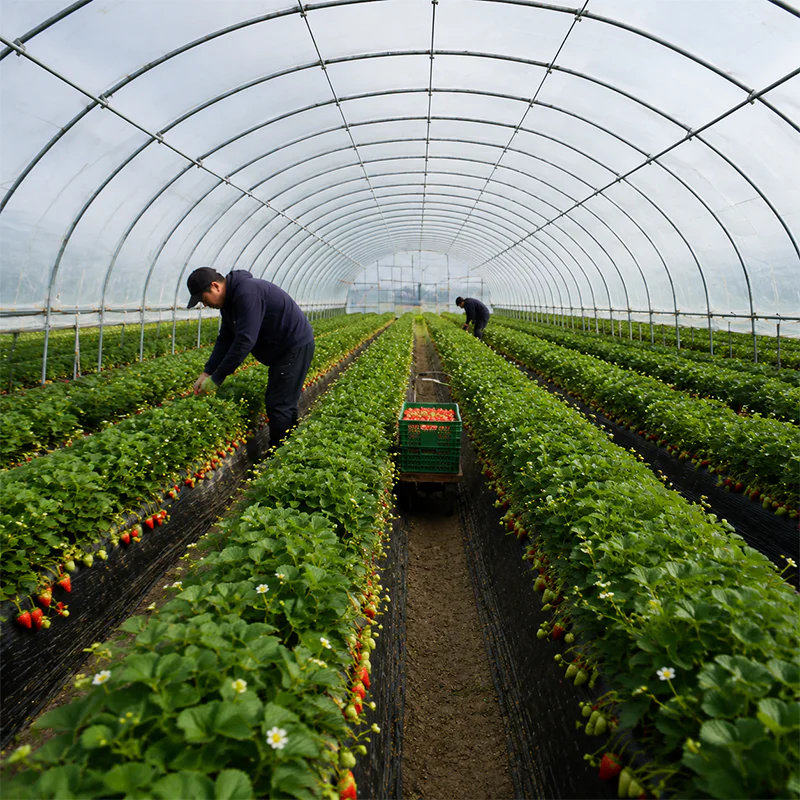
Small tunnel greenhouses are common for entry level commercial growers. They are usually easier to install and more affordable than large multi span structures. They are suitable for seasonal vegetables, leafy greens, herbs, and crop trials.
Single Span Greenhouses for Small and Medium Production
Single span greenhouses provide more organized production space than simple tunnels. They can be used for vegetables, flowers, nursery plants, strawberries, and hydroponic systems. A single span structure is suitable when the grower needs better management but does not yet require a large multi span project.
Multi Span Greenhouses for Professional Large Scale Farming
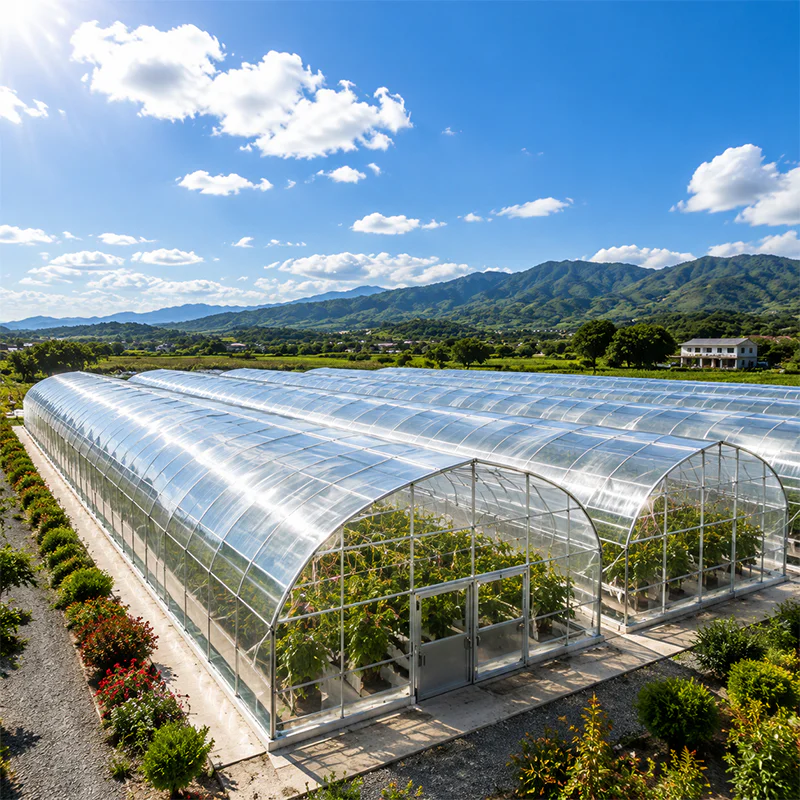
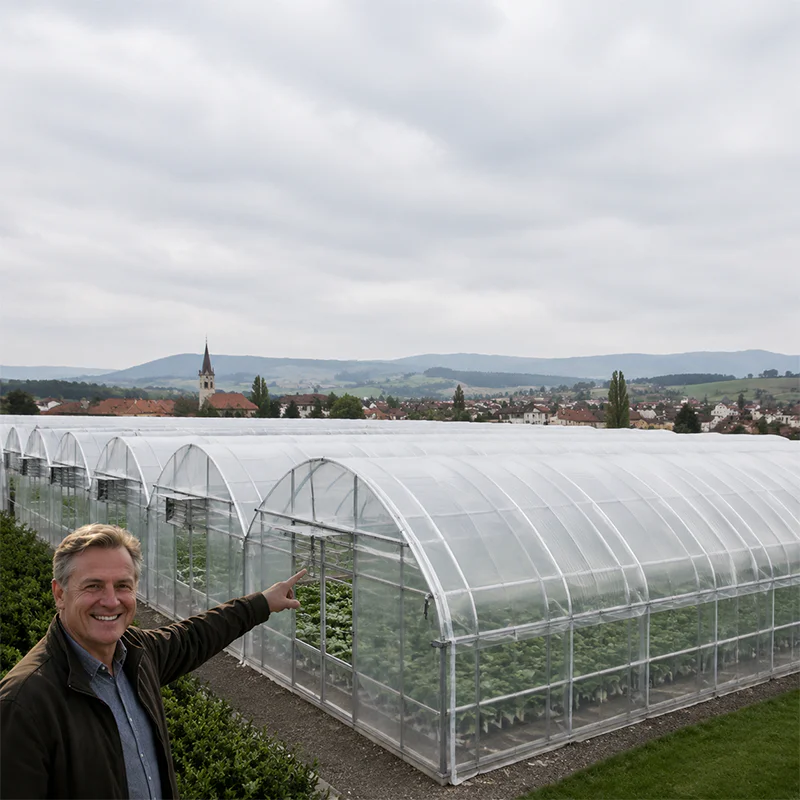
Multi span greenhouses connect several spans into one larger structure. They are widely used for professional commercial production because they improve land use efficiency, internal workflow, and equipment integration.
For growers planning long term production, multi span greenhouses can support more advanced systems such as cooling, shading, fertigation, heating, and automatic control.
How to Choose Between Tunnel, Single Span and Multi Span Structures
Choose a small tunnel if your budget is limited or you are testing a new crop. Choose a single span greenhouse if you need more stable production for a small or medium farm. Choose a multi span greenhouse if your goal is large scale commercial farming, higher land use efficiency, and better climate control.
Small Tunnel Greenhouse Sizes for Commercial Starters
A small tunnel greenhouse is often the first step for commercial growers. It provides protected growing space without requiring the same investment as a large commercial project.
Common Small Tunnel Sizes: 20×50 ft, 30×60 ft and 30×100 ft
Common small tunnel sizes include 20×50 ft, 30×60 ft, and 30×100 ft. These standard greenhouse sizes are widely used because they are practical for planting rows, irrigation lines, and simple farm management.
A 20×50 ft tunnel can be used for small production or trial planting. A 30×100 ft tunnel provides more commercial potential and is often suitable for vegetables, flowers, or local market production.
Suitable Crops for Small Tunnel Greenhouses
Small tunnel greenhouses are suitable for leafy greens, herbs, strawberries, seedlings, flowers, peppers, and seasonal vegetables. They can also support soil planting, raised beds, or simple irrigation systems.
However, tall crops such as tomatoes and cucumbers may require enough height and stronger ventilation planning.
Best Use Cases: Trial Planting, Seasonal Production and Local Markets
Small tunnels are useful when growers want to test a crop before scaling up. They are also suitable for seasonal production, farm direct sales, and restaurant supply.
For example, a small farm can use a tunnel greenhouse to grow lettuce and herbs for local restaurants, then expand later if demand becomes stable.
Limitations of Small Tunnel Greenhouses in Commercial Farming
Small tunnels have limited internal space, limited automation potential, and lower land use efficiency compared with multi span structures. If the market demand increases quickly, a small tunnel may become insufficient.
Single Span Greenhouse Sizes for Small and Medium Farms
Single span greenhouses are suitable for growers who need more reliable production space but still want to control investment.
Typical Width, Length and Height of Single Span Greenhouses
Single span greenhouses may use widths around 20 to 30 ft, with lengths depending on land and production needs. Height should be selected according to crop type. Leafy greens need less height, while tomatoes, cucumbers, hanging baskets, and trellised crops need more vertical space.
The right single span greenhouse size should include planting rows, work aisles, irrigation space, and harvest access.
When Single Span Greenhouses Are More Cost Effective
Single span greenhouses can be cost effective for small and medium farms because they are easier to build and manage than large multi span systems. They are suitable when growers want commercial production but do not need a large connected structure.
Crop Layout, Walkways and Equipment Space in Single Span Greenhouses
A good layout should leave space for main walkways, side aisles, irrigation pipes, tools, fans, and crop maintenance. Growers should calculate usable growing area instead of only total floor area.
Expansion Challenges of Single Span Greenhouse Projects
Single span greenhouses can be expanded by adding more separate units, but this may create duplicated sidewalls, more walking distance, and less efficient land use. If expansion is expected, growers should plan the greenhouse direction and spacing early.
Multi Span Greenhouse Sizes for Professional Growers
Multi span greenhouses are designed for professional commercial farming where efficiency, scale, and control are important.
What Is a Multi Span Greenhouse?
A multi span greenhouse is a structure made by connecting multiple greenhouse spans side by side. This creates a large continuous growing area under one roof. It is commonly used for vegetables, flowers, nursery plants, berries, and hydroponic farming.
Common Multi Span Greenhouse Widths, Bay Lengths and Gutter Heights
Multi span greenhouse dimensions vary by design. Important parameters include span width, bay length, gutter height, ridge height, column spacing, and structural load. The final design should match crop height, equipment needs, and local climate.
For commercial projects, the average greenhouse size is often discussed in square meters because large structures need more accurate layout and equipment planning.
Why Multi Span Greenhouses Improve Land Use Efficiency
Multi span greenhouses reduce repeated sidewalls and make better use of available land. They also allow more efficient movement of workers, carts, irrigation systems, and harvesting operations.
Compared with several separate tunnels, a multi span structure can provide better internal organization and more consistent growing conditions.
Suitable Crops for Multi Span Greenhouses
Multi span greenhouses are suitable for tomatoes, cucumbers, peppers, lettuce, herbs, strawberries, flowers, nursery crops, and hydroponic vegetables. They are especially useful for crops that need stable climate control and long production cycles.
When a Farm Should Upgrade from Single Span to Multi Span
A farm should consider upgrading when production demand becomes stable, labor cost increases, or separate tunnels no longer provide enough efficiency. If the grower needs better climate control, more automation, or higher land use efficiency, a multi span greenhouse is often a better long term solution.

Commercial Greenhouse Size Recommendations by Business Model
The right greenhouse size should match the business model. Different sales channels require different planting capacity and harvest stability.
Greenhouse Size for Restaurant Vegetable Supply
For restaurant supply, a small to medium greenhouse can be enough if the goal is to provide fresh herbs, lettuce, and specialty greens. The greenhouse size should be based on the restaurant’s weekly consumption, crop cycle, and usable growing area.
Greenhouse Size for Farmers Market and Local Sales
For farmers market sales, growers need stable harvest volume and product variety. A 30×100 ft tunnel or multiple single span greenhouses may be suitable for leafy greens, herbs, flowers, and seasonal vegetables.
Greenhouse Size for Wholesale Vegetable Production
Wholesale vegetable production usually requires larger commercial greenhouse sizes. Growers should plan based on target yield, delivery frequency, and buyer requirements. Multi span greenhouses are often more practical for this model.
Greenhouse Size for Nursery and Seedling Production
Nursery and seedling production needs space for trays, benches, propagation areas, transplanting, and plant movement. The greenhouse should have enough working space, not only planting space.
Greenhouse Size for Hydroponic Commercial Farming
Hydroponic commercial farming requires space for growing systems, nutrient tanks, pumps, filters, pipes, and maintenance access. The greenhouse size should be planned together with the hydroponic layout.
How Crop Type Affects Commercial Greenhouse Size
Crop type is one of the strongest factors affecting greenhouse size.
Leafy Greens and Herbs: High Density Production in Smaller Areas
Leafy greens and herbs can be grown at high density. They are suitable for small tunnels, single span structures, and hydroponic systems. However, growers still need enough space for harvesting, airflow, and disease prevention.
Tomatoes, Cucumbers and Peppers: More Height and Aisle Space Required
Tomatoes, cucumbers, and peppers need more height, wider aisles, and strong trellising support. A greenhouse that is too low or narrow can reduce work efficiency and crop quality.
Strawberries and Berries: Layout Based on Gutters, Benches or Containers
Strawberries may be grown in ground beds, gutters, benches, or hydroponic troughs. Each system requires a different layout. Berries in containers need more spacing and access for pruning and harvesting.
Flowers and Nursery Plants: Space for Benches, Pots and Plant Movement
Flowers and nursery plants often need benches, pots, trays, sorting areas, and movement space. A crowded greenhouse can make plant management difficult and increase damage during handling.
How to Calculate the Right Commercial Greenhouse Size
Choosing the right commercial greenhouse size should involve calculation, not guessing.
Start with Target Yield and Harvest Frequency
Begin with your target output. Ask how much produce you need per week or per month. Then calculate how many plants are required to reach that target.
Estimate Planting Density and Crop Cycle
Planting density and crop cycle determine how much area you need. Leafy greens may have a shorter cycle and higher density, while fruiting crops need longer cycles and more space.
Reserve Space for Walkways, Irrigation and Equipment
Do not use the entire greenhouse area for planting. Reserve space for walkways, irrigation systems, fans, tanks, tools, and work areas. This improves daily operation and reduces management problems.
Calculate Usable Growing Area Instead of Total Area
Total greenhouse area and usable growing area are not the same. A 1,000 sqm greenhouse does not mean 1,000 sqm of crop space. Walkways, equipment, and working zones reduce usable area.
Match Greenhouse Size with Budget and Payback Period
The best size should match your investment plan and expected payback period. A larger greenhouse may improve production capacity, but it also increases structure cost, equipment cost, and operating cost.
Key Factors That Affect Commercial Greenhouse Size Planning
Several practical factors must be reviewed before finalizing the greenhouse size.
Available Land and Site Layout
Land shape, road access, drainage, sunlight, and future expansion space all affect greenhouse planning. A suitable site layout can reduce installation difficulty and improve operation.
Local Climate, Wind Load and Snow Load
Wind, snow, heat, humidity, and rainfall can influence greenhouse structure and size. In areas with strong wind or snow, the greenhouse frame and roof design must be selected carefully.
Ventilation, Cooling, Heating and Shading Systems
Larger greenhouses usually need more systematic climate control. Ventilation, cooling, heating, and shading should be considered during the size planning stage, not after installation.
Labor Efficiency and Daily Operation Flow
A greenhouse should support smooth movement of workers, carts, tools, and harvested crops. Poor layout can waste labor time every day.
Future Expansion and Long Term Farm Planning
If your market may grow, reserve space for future expansion. Planning expansion early is usually more cost effective than redesigning the farm later.
Standard Commercial Greenhouse Sizes vs Custom Designed Greenhouses
Both standard and customized greenhouse designs can work well, depending on the project.
Benefits of Standard Greenhouse Sizes for Commercial Projects
Standard greenhouse sizes are easier to quote, produce, ship, and install. They are suitable for common crops and simple commercial projects.
When Custom Greenhouse Size Is Better for Professional Farming
Custom design is better when the project has special crops, hydroponic systems, local climate requirements, irregular land, or future expansion plans. For professional farming, custom design can improve long term production efficiency.
How Custom Design Affects Cost, Installation and Production Efficiency
Custom greenhouse size may require more design work and longer preparation time. However, it can improve space utilization, equipment layout, and crop management. For larger projects, this can create better long term value.
Cost Considerations for Different Commercial Greenhouse Sizes
Greenhouse size directly affects cost, but the lowest price is not always the best choice.
Why Larger Greenhouses Do Not Always Mean Better Profit
A larger greenhouse can produce more crops, but it also requires more capital, labor, water, fertilizer, and energy. Profit depends on market demand and management ability, not only growing area.
Structure Cost, Covering Material and Equipment Cost
The main cost includes steel structure, covering material, doors, ventilation, irrigation, shading, cooling, heating, and control systems. Larger commercial greenhouse sizes usually require more complete equipment.
Installation, Shipping and Maintenance Cost
Installation and shipping cost should be included in the budget. Maintenance cost also increases with size, especially when the greenhouse includes automatic systems.
How Greenhouse Size Influences Long Term Return on Investment
The right greenhouse size can improve ROI by balancing production capacity and operating cost. Growers should compare expected output, crop price, labor needs, and payback period before deciding.

Common Mistakes When Choosing Commercial Greenhouse Sizes
Avoiding common mistakes can reduce investment risk.
Choosing Size Only Based on Initial Price
Some growers choose the smallest option to save money, but later find that production capacity is not enough. Initial cost matters, but long term value matters more.
Ignoring Usable Growing Area
Total area can be misleading. Always calculate usable growing area after reserving space for aisles, equipment, and operation.
Underestimating Space for Workers and Equipment
Workers need space to plant, prune, harvest, clean, and maintain systems. Equipment also needs safe access. A crowded layout can reduce efficiency.
Building Too Small for Future Market Demand
If the market demand grows, a too small greenhouse may limit business development. It is better to plan expansion direction from the beginning.
Choosing Multi Span Greenhouses Without Proper Planning
Multi span greenhouses are powerful commercial structures, but they need proper planning. Span width, height, ventilation, drainage, and equipment layout should be designed before production.
How Aurlant Helps Plan Commercial Greenhouse Sizes
Aurlant helps growers choose suitable commercial greenhouse solutions based on crop type, land condition, climate, budget, and market goal.
Greenhouse Size Suggestions Based on Crop and Market Goal
Aurlant can recommend greenhouse size according to your crop and sales plan. Whether you grow vegetables, flowers, nursery plants, strawberries, or hydroponic crops, the size should match the production target.
Small Tunnel, Single Span and Multi Span Greenhouse Solutions
Aurlant provides greenhouse solutions from small tunnel greenhouses to single span and multi span greenhouse projects. This allows growers to choose a structure that matches their current stage and future plan.
Customized Layout Design for Commercial Greenhouse Projects
For commercial projects, Aurlant can support customized layout design, including planting zones, walkways, ventilation, irrigation, and equipment space.
Quotation Support Based on Size, Structure and Equipment Configuration
Aurlant can provide quotation support based on greenhouse size, structure type, covering material, and equipment configuration. This helps growers compare investment options more clearly.

FAQ About Standard Greenhouse Sizes for Commercial Farming
What Are Standard Greenhouse Sizes for Commercial Farming?
Common standard greenhouse sizes for commercial farming may start from 20×50 ft or 30×100 ft for small tunnel production.
What size greenhouse is good for a small commercial farm?
A 30×100 ft tunnel or a medium single span greenhouse can be a practical starting point for small commercial farms. The final size should match crop type, budget, and target sales volume.
Is a tunnel greenhouse suitable for commercial production?
Yes, a tunnel greenhouse can be suitable for entry level commercial production, seasonal vegetables, herbs, flowers, and local market sales. However, it may have limitations in automation, climate control, and expansion.
What is the standard size of a multi span greenhouse?
There is no single standard size for every multi span greenhouse. Common designs depend on span width, bay length, gutter height, crop type, and local structural requirements. Professional design is recommended before ordering.
How many square meters are needed for commercial greenhouse farming?
The required area depends on crop type, planting density, crop cycle, and sales target. A small project may need only a few hundred square meters, while larger commercial farms may require thousands of square meters.
Is a multi span greenhouse better than a single span greenhouse?
A multi span greenhouse is usually better for large scale production, land use efficiency, and advanced climate control. A single span greenhouse may be more cost effective for small or medium farms with limited investment.
Заключение
Choosing the right commercial greenhouse size requires a clear understanding of crop needs, business goals, site conditions, budget, and future expansion. A small tunnel greenhouse can be a practical starting point for trial growing or local sales. A однопролетная теплица can support small and medium production with controlled investment. A multi span greenhouse is more suitable for professional growers who need large scale production, better land use, and stronger climate control.
The best commercial greenhouse size is not always the largest size, but the size that supports stable production, efficient labor, reasonable cost, and long term return. Before making a final decision, growers should calculate usable growing area, equipment space, crop cycle, market demand, and payback period.
With proper planning, standard greenhouse sizes and customized greenhouse solutions can both create strong value for commercial farming. Aurlant can help growers evaluate standard greenhouse sizes, customized layouts, and suitable structures for different crop and market goals.